

Recently, according to German media Autohausem>, BMW Group may start canceling the authorized dealer system for the MINI brand in the German market from 2024, and the BMW brand may cancel the authorized dealer system from 2026 onwards, adopting a new agency model for new car sales in the future.
(Image source: BMW China)
In fact, Honda has already canceled its traditional operation model of selling new cars through 4S stores in Australia since July 1 last year. The 106 authorized car dealers in Australia will no longer sell Honda new cars, and Australian users will only be able to purchase from the brand's official website in the future.
Mercedes-Benz has also stated that it will start direct sales models in Germany and the UK from 2023, planning to reduce dealer coverage by about 15% to 20% in Germany by 2028.
The emergence of transformation plans from mainstream automakers has accelerated the "disintegration" of the traditional dealer model, making the topic of where 4S stores will go a hot debate in the industry once again.
1. Replacing the traditional sales model: Agency model or direct sales model
Currently, mainstream automakers are canceling the traditional dealer model, replacing it with either the agency model or the direct sales model.
The agency model takes BMW as an example.
In its channel adjustment statement, BMW Group stated that it will adopt a new agency model in Europe, but also emphasized that dealers will remain the pillar of its sales success in the future.
According to the latest data released by BMW, the BMW brand has over 3,500 dealers in its global sales network. It seems BMW is adopting a compromise solution, retaining the old dealer system while introducing new decentralized agents.
The direct sales model is represented by Mercedes-Benz. According to the April issue of Manager Magazin, Mercedes-Benz will start direct sales in Germany and the UK from 2023.
The plan is to reduce dealer coverage by about 15%-20% in Germany by 2028 and transition to a digital sales model. Previously, Mercedes-Benz's direct sales operations in South Africa and Sweden have achieved good results.
Among the transformation plans, the direct sales model has the greatest impact on the traditional dealer model.
McKinsey's 2021 automotive consumer survey found that consumers prefer direct interaction with OEMs. Direct sales models offer transparent pricing, allowing consumers to check full vehicle prices online, and traditional dealers may directly transform into service providers for sales consulting, test drives, after-sales, etc.
Although the direct sales model brings significant financial and operational pressure to OEMs, new carmakers like Tesla and NIO have led a wave of direct sales, gaining a large number of loyal fans and creating a "car owner effect," which many traditional automakers are learning from.
2. Pre-sales and after-sales fully digitized
As "digitalization" deepens, the automotive industry's digital transformation is at the forefront. Besides digitizing new car sales, traditional automakers are also trying to communicate and interact more directly with car owners through online and offline channels to enhance the car buying and after-sales experience.
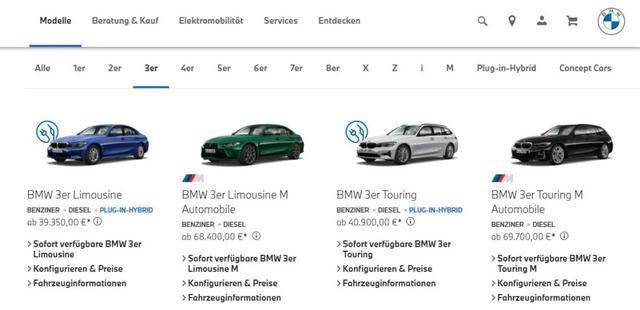
BMW was the first in Germany to launch online purchase services, and new energy vehicle makers like Tesla and XPeng also achieve seamless connections with car owners through online appointments + offline direct display and test drives.
(Image source: BMW Germany official website)
On the after-sales business side, OEMs are gradually focusing on repairs, insurance, finance, etc., to drive digital transformation and upgrading.
As early as September 2020, BMW's after-sales service department was officially renamed BMW Customer Service and Support, successively launching the BMW Cloud Connected APP, BMW Customer Service Center WeChat public account, My BMW APP, and other digital solutions to further improve digital service methods and create a "socialized brand experience."
The OEMs' "digitalization" actions indicate that the digital era of the entire automotive industry chain has arrived.
3. 4S system shaken, what about the after-sales response?
OEMs' channel transformations will inevitably trigger chain reactions, affecting not only new car sales but also the broader after-sales maintenance market.
(1) Opportunity for independent after-sales systems?
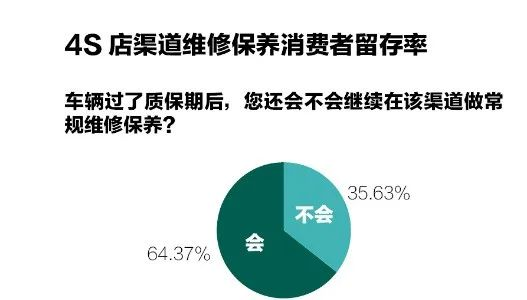
According to the 2021 China Automotive Aftermarket Consumer Survey, nearly 36% of customers leave 4S stores after the warranty period and choose other channels. Where do these customers who leave the 4S system ultimately go?
-- Independent after-sales systems!
(Image source: 2021 China Automotive Aftermarket Consumer Survey)
But for auto repair shops in independent after-sales systems, it may not be a piece of cake. In previous media reports, some operators said: "Originally, 4S stores had a monopoly, so we didn't compete. Now with more customers, everyone might fight even harder than before!"
More stores will try every means to grab that 36% customer share, and for 400,000 auto repair shops, the future customer competition pressure may be even greater.
(2) Small but powerful, after-sales business space still has great potential
Since 2015, as new car sales growth has slowed, dealer groups have intensified expansion into after-sales business. More dealer investors want to break free from the 4S model, strip away the "burden" of new car sales, and obtain various after-sales service authorizations as "service providers."
OEMs handle "interaction and transactions" with car owners, service providers handle service "delivery," seeking new growth points in the stock market.
The results of the 2021 National Automotive Dealer Survival Survey show that after-sales business still contributes over 50% of dealer profit structure.
Among them, according to dealer financial reports released in March, Guanghui Baoxin's 2021 automotive sales gross profit accounted for 22.1%, while after-sales business gross profit accounted for 76.8%; Meidong Auto's after-sales service business base expanded significantly, with revenue increasing 22.0% year-over-year.
It is not difficult to see that after-sales business remains the backbone of dealer profitability.
In after-sales business, insurance and finance are greatly affected by policies, while the growth value of repairs is increasingly prominent. However, parts procurement requires high professional skills and supply chain services, and how to solve these problems has always troubled dealers.
It is understood that many top 100 dealers have ushered in the "spring" of after-sales business by utilizing digital systems. Through procuring Baturu's group purchasing SaaS + supply chain services, they have achieved full online process for parts group purchasing from inquiry, comparison, ordering, payment, delivery, after-sales, to reconciliation, building a more efficient, compliant, and intelligent parts digital procurement system, optimizing parts group purchasing and internal management, achieving operational efficiency improvements and cost reductions, with cost reduction effects up to over 10%.
In fact, digitalization has penetrated the entire automotive industry chain. Before the industry reshuffle period arrives, OEMs and dealers' transformations have long been foreseeable. As the Chinese automotive market shifts from incremental to stock market, value yields are also shifting toward after-sales, and more top 100 dealers are fully enhancing after-sales output value.
News Center
- Baturu and Lida Consulting Enter into Strategic Partnership to Jointly Tackle the Challenges Facing Car Dealers in the Accident-Damaged Vehicle Sector
- Baturu Retains ‘Supply Chain Excellence Enterprise’ Title at the Kasfu Awards, with Its Digital Capabilities Once Again Recognised by the Industry
- Baturu was invited to attend the 2026 China Automotive Circulation Conference and delivered a keynote speech
- Baturu delivered a keynote speech at the Automotive Industry Export Conference
- Baturu won the Brand Influence Award for Benchmark Enterprises in Guangzhou Automotive Service Industry in 2025