

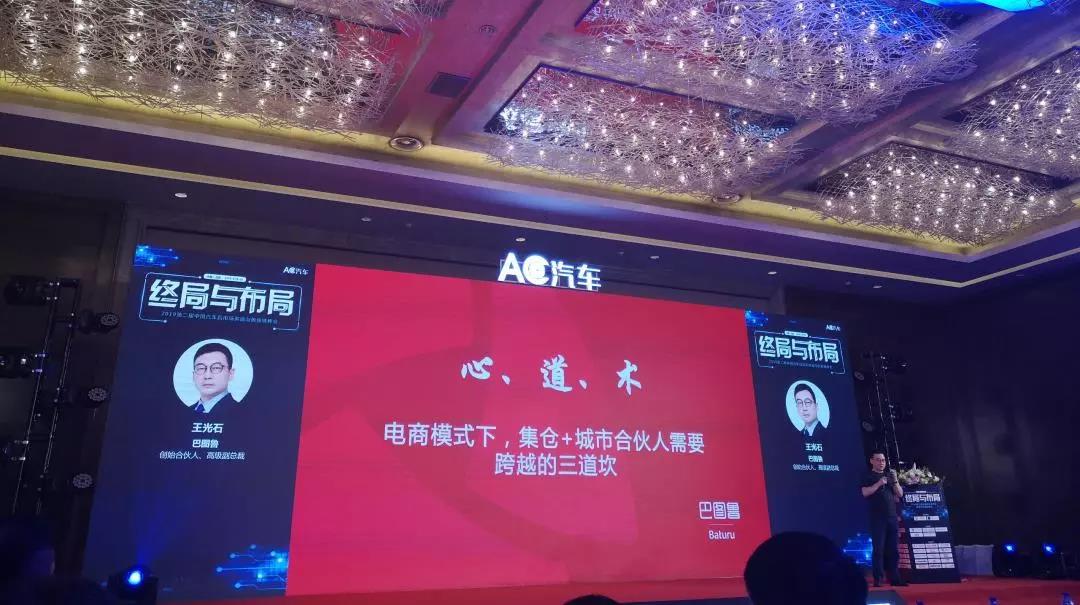
This article is based on a speech by Wang Guangshi, Founding Partner and Senior Vice President of Baturu, at the "2019 Second China Automotive Aftermarket Channel and Supply Chain Summit - Endgame and Layout" forum hosted by AC Auto.
Baturu has encountered some challenges in the projects of centralized warehouses and city partners, or rather, every important choice is a hurdle that needs to be overcome. These choices and decisions are not numerous, but they are the most critical. Looking back at Baturu's development journey, the hurdles we faced or the choices we made can be divided into three levels.
The first hurdle is Baturu's self-positioning.In the automotive aftermarket supply chain, whether you are making connections, developing channels, or focusing on breakthroughs in a certain dimension, or doing anything else, it all has value and significance. >Baturu positions itself as a high-quality service automotive aftermarket infrastructure platform. We hope that every node in the upstream and downstream of the automotive aftermarket can reduce costs, increase efficiency, and achieve cross-regional development through this platform.We are neither a link in the aftermarket circulation nor a simple connecting pipeline. What we wantd is infrastructure, which has been our unwavering choice for five years and is also the biggest hurdle we have faced.
Since we have already determined our positioning, the next question is what strategy and methods to use to complete the construction of Baturu's infrastructure.
Baturu's business model can be divided into online and offline aspects. Online, we need to achieve two goals: meet users' auto parts purchasing needs and connect upstream and downstream merchants. Through one-stop information acquisition on the platform an online order generation, the industry can break free from dependence on professional personnel.
After five years, in the South China region where started earliest, the automatic order processing rate has reached over 70%, orders can be generated without manual intervention, and order payments can also be completed online
At this point, we faced another choice: after Baturu solved the effective online connection of supply and demand, should we continue to handle offline delivery? This is a choice and also thed hurdle.
If we do offline, warehousing and logistics are problems we need to solve. We have been in the auto parts distribution business for over 20 years in the automotive aftermarket. Traditional offline dealers are still troubled by warehouse aneding to build their own teams and manage their inventory, both incoming and outgoing. But nowadays, few young people are willing to work in this industry, and building an effective team is extremely costly. This has always been a problem we hope doing traditional auto parts distribution.
Ultimately, we decided to develop the offline business which is also a veryLooking back, when we were doing offline business, both domestically and internationally, we had not seen a complete and mature-range parts central warehouse. There are some full-range parts warehouse management in China's 4S, but from both brand and quality perspectives, the variety is insufficient. We truly could not find a suitable for genuine automotive aftermarket full-range parts warehouse management.
Especially for last-mile delivery, who should complete it? For full-range parts, whether online or offline, after-sales issues are inevitable. Without an effective solution, customer delivery experience cannot be guaranteed.
Therefore, in Baturu's business model, we position the central warehouse and city partners as strategic layout.
Now we can see that Baturu's Smart Central Warehouse has achieved coverage of all vehicle types and all categories of auto parts. Baturu's Smart Central Warehouse does not require people with auto parts experience to manage it. Currently, the four major central warehouses nationwide are basically managed by people without auto parts experience, through information systems.

At the final delivery end, our partners are creating value for customers while also creating wealth for themselves. Previously, many partners only conducted transactions, but now they provide services for transactions, and a new profession has emerged. They are providing services to the aftermarket industry, and also enabling Baturu's business to form a final closed loop.
At the third level, the problem we encountered is: after the warehouse is built, who will use it? How to use it effectively?We naturally hope that full-range parts suppliers and downstream repair shops will use the infrastructure we provide. But if they use it, the platform's products must first be standardized, because only standardized products can we manage precisely. The reality is that traditional aftermarket auto parts merchants each have their own standards, some high and some low. Even if merchants recognize our warehousing model, when they actually use it, they encounter problems due to lack of unified standards. So we need to help users organize their data and standardize their products. This process has slowed down the promotion of central warehouses. Even though we had anticipated this problem, the actual situation was still unexpected.
Each region where we promote the central warehouse requires substantial work. This is very challenging, but someone must do it.
Suppliers who standardize their core data quickly have indeed experienced the benefits that Baturu's infrastructure brings to them.For example, some South China suppliers have already experienced a complete change in their work scenario. On the front end, Baturu city partners will develop the market without suppliers needing to be involved; on the back end, delivery management is also not handled by suppliers. Suppliers have eliminated their own warehouse and logistics management teams and only need to focus on their core work, which is researching product layout and adjusting product strategies based on operational data.
Suppliers gradually realize that this effect and result is what they hoped to achieve. They begin to learn how to read data and conduct data analysis. This process is actually very difficult, and initially we even had to overcome some psychological barriers of suppliers, helping them analyze what they should do in the future.
At the partner level, the most difficult hurdle is whether partners, as a new profession, can survive, make money, and achieve good development.To be frank, currently in Baturu's partner system, although some partners have broken through the survival period and moved forward, such as a partner in a certain area of Shenzhen who has already achieved monthly transaction volumes of 3 million. However, a considerable number of partners are still in the survival period and have not yet crossed this survival hurdle. How to help partners understand Baturu's value and accurately convey it to customers is equally challenging.
At the customer level. Baturu has invested enormous energy and capital in building industry infrastructure. Just the investment costs in warehousing and partners alone are at least 10% higher than traditional suppliers. Will customers accept such pricing? If they do accept it, what would be their reasons? These are all problems we face.
From Baturu's perspective, after operating in several major regions, I believe our industry infrastructure is now beginning to take effect. Our suppliers are changing, our partners are growing, and our customers, especially compliant enterprises, are pursuing stable long-term development. For these qualified and compliant enterprises, Baturu provides not just auto parts, but solutions for auto parts procurement. This solution involves not only the price of parts but also the costs of legal and compliant delivery, etc.
Finally, regarding investment in the industry, no enterprise's development can be separated from capital. We face the same choice: should Baturu continue to focus on scale expansion in the future, or focus on sustainable development and health? We need to balance between them and continuously make choices and face challenges.
So, at every stage, we encounter hurdles. But this industry requires persistence and commitment. I hope friends in the aftermarket can communicate and exchange more. Through our efforts, let this industry undergo more changes.
News Center
- Interview with Baturu Zeng Wangui: Completing the cycle of transformation. An automotive parts "master" discovers a new rhythm for digitalized procurement
- Teda Forum | Baturu Founder and Chairman Zeng Wan Gui: Digital Platforms Empower Automobile Dismantling and Aftermarket Parts Circulation
- Qulian Car Dealers | Social Responsibility Model Case | Baturu: Strengthen Services, Promote Employment, Emphasize Management
- Auto Parts Circle | SaaS products growing at nearly 30% speed, what services do they provide for the automotive aftermarket sector?
- Jiemian News | Pazhou, Guangzhou: From Urban "Siberia" to Industrial Internet High Ground